



Is a Single Port Enough, or Is a Dual Port Better? A Comprehensive Review of ...
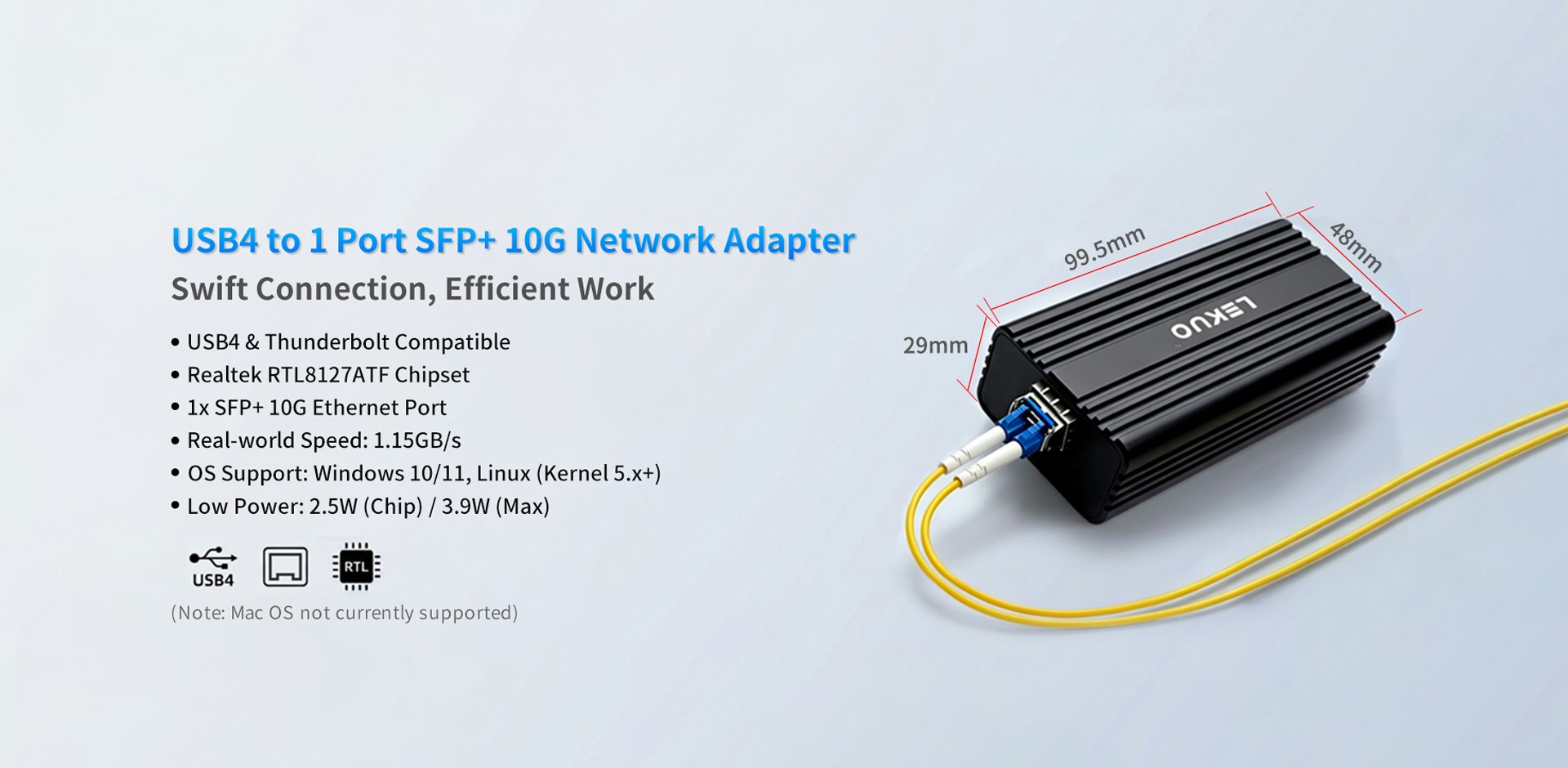
Addressing pain points such as the lack of PCIe slots in laptops, NUC mini PCs, mobile workstations, and industrial equipment—which prevents the expansion of 10 Gigabit SFP+ ports—as well as the need for both single- and dual-link solutions and inconsistent system compatibility, LeKuo has introduced two USB4-to-10Gb SFP+ fiber network adapter solutions: the DTB3F11 (single-port) and the DTB3F22 (dual-port). Both products are equipped with the Realtek RTL8127ATF 10Gb network chip, enabling high-speed 10Gb fiber network expansion for devices via the USB4 interface.
Analysis of the Core Architecture: Same RTL8127ATF Platform, Different Design Targets
Both products are equipped with the Realtek RTL8127ATF dedicated Ethernet chip, which is optimized for SFP+ 10 Gigabit optical ports. It supports 10 Gbps line-rate forwarding at the hardware level, with a power consumption of just 2.5W. The chip delivers low latency, low CPU utilization, and high stability, and has been tested to achieve internal network transfer speeds of approximately 1.15 GB/s.
Differentiated single-port and dual-port designs for precise adaptation to various scenarios
1. Optical port configuration: Single-port portable vs. dual-port multi-link
DTB3F11: Single USB4 40Gbps upstream port (compatible with Thunderbolt 3/4/5) + 1 SFP+ 10GbE port, bus-powered, ultra-portable
DTB3F22: Dual USB4 40Gbps ports (1 upstream + 1 downstream) + 2 SFP+ 10 Gigabit Ethernet ports, external power supply, supports USB4/Thunderbolt device expansion
Features | DTB3F11 | DTB3F22 |
Number of fiber ports | 1 SFP+ 10 Gigabit Ethernet port | 2 independent SFP+ 10 Gigabit Ethernet ports |
Supported speeds | 10GBASE-R/1000BASE-X auto-negotiation | 10GBASE-R/1000BASE-X auto-negotiation |
Core Strengths | Single-port, high value for money, meets basic 10 Gigabit requirements | Dual links operate independently, supporting link aggregation and separation of internal and external networks, as well as expansion via USB4/Thunderbolt devices, |
2. Interfaces and Cascading: Pure Network Expansion vs. Network + Peripherals Combo
●DTB3F11: Retains only the essential USB4 upstream port and focuses on 10 Gigabit Ethernet expansion, making it ideal for laptops with extremely limited ports.
●DTB3F22: Equipped with a USB4 downstream port, it supports USB4/Thunderbolt device expansion: You can daisy-chain Thunderbolt displays, docking stations, external hard drives, and other peripherals to achieve a “10 Gigabit Ethernet + peripheral expansion” two-in-one solution, completely resolving the issue of insufficient Thunderbolt ports.
3. Power Supply and Power Consumption: Bus-Powered Portability vs. External Stability
Features | DTB3F11 | DTB3F22 |
| Power Supply | USB4 Power Delivery | 12V/3A External Power Adapter |
| Typical Power Consumption | Total power consumption is approximately 3.9 W | Total power consumption is approximately 7.4 W |
| Key Advantages | No external power source required; plug-and-play; highly portable | Power supply is sufficient, and both optical ports operate stably under full load simultaneously. |
4. System Compatibility:
DTB3F11 and DTB3F22: Compatible with Windows 10/11 and Linux; currently not compatible with macOS
5. Enterprise-Grade Features: Comprehensive Support Across All Models
Both products offer a full suite of enterprise-grade networking features:
● Support for 16KB jumbo frames, significantly reducing protocol overhead
● Support for IEEE 802.1Q VLAN and 802.1ad Q-in-Q dual VLAN
● Support for Wake-on-LAN remote wake-up and PXE+EFI dual-mode network booting
● Supports full-duplex flow control (IEEE 802.3x) for lossless data transmission
Real-world Scenarios: Choose Based on Needs to Precisely Address 10GbE Upgrade Challenges
Scenario 1: 10GbE Upgrade for Personal Laptops/Mobile Office
Requirements: For business travel and home use, requires a portable 10 Gigabit Ethernet connection without the need for an external power source
Recommended Product: DTB3F11
Solution Benefits: Bus-powered, no external power required; compact and portable; simply plug into a Thunderbolt port to use
Performance: Direct 10GbE fiber connection between laptop and NAS; large file backup speeds 10 times faster than Gigabit; smooth, lag-free online preview of 4K footage
Scenario 2: Multi-device connectivity in a content creation studio
Requirements: Simultaneous connection to a NAS media library and the office network; requires external peripherals such as monitors and hard drives
Recommended Product: DTB3F22
Solution Benefits: Dual optical ports connect the NAS and switch, respectively; the Thunderbolt downstream port daisy-chains the monitor and docking station, resulting in a clean and efficient workspace
Performance: Real-time preview of multi-track 4K footage and lag-free rendering output; simultaneous connection of peripherals and network devices without frequent plugging and unplugging
Scenario 3: High-Speed NAS Interconnection and Link Aggregation
Requirements: Increase NAS transfer speeds, enable concurrent multi-user access without bottlenecks, and support link redundancy
Recommended Product: DTB3F22
Solution Benefits: Dual fiber ports support link aggregation, increasing total bandwidth to 20 Gbps without occupying the NAS’s native ports
Actual Performance: Multi-user simultaneous access to the NAS and large file sharing speeds are doubled; a single link failure does not affect network connectivity
Scenario 4: Industrial Edge Computing Node
Requirements: A stable 10 Gigabit network connection is required in industrial environments, with wide-temperature operation and support for multi-link redundancy.
Recommended Product: DTB3F22
Solution Benefits: All-metal passive cooling, wide-temperature operation from 0°C to 85°C, and dual optical ports for link redundancy.
Actual Performance: High-speed data backhaul from edge nodes, with the device operating stably 24/7.
Key Specifications Comparison Chart: A Visual Guide to the Differences Between the Two Products
Performance Specifications | DTB3F11 | DTB3F22 |
Number of optical ports | 1 SFP+ 10 Gigabit Ethernet port | 2 SFP+ 10 Gigabit Ethernet ports |
USB4 port | 1 (Uplink only) | 2 (1 upstream + 1 downstream in cascade) |
Power Supply Method | USB4 Power Delivery | 12V/3A external power supply |
Typical power consumption | Total power consumption is approximately 3.9 W | Total power consumption is approximately 7.4 W |
System Support | Windows10/11、Linux4 | Windows10/11、Linux |
Lightning Cascade | Not supported | Support |
Core Positioning | Personal, portable, single-link 10 Gigabit | Professional studio, dual-link aggregation, peripheral expansion |
Summary
The LeKuo DTB3F11 and DTB3F22 USB4-to-10Gb SFP+ fiber network adapters are both based on the same high-performance RTL8127ATF chip. Through differentiated interface designs, power supply solutions, and system compatibility, they precisely address the 10Gb fiber network upgrade needs of different users:
● For portability and single-link requirements: The DTB3F11 is the top choice, featuring ultra-low power consumption of 2.5W and bus-powered operation for plug-and-play functionality
● For dual-port link aggregation, USB4/Thunderbolt device expansion, and industrial-grade wide-temperature operation: The DTB3F22 is the top choice, featuring dual Ethernet ports and daisy-chain functionality for full compatibility with professional scenarios
No need to open the case or use a PCIe slot—simply plug it into a Thunderbolt port to enjoy the high speed and stability of a 10 Gigabit fiber network. This is the optimal solution for 10 Gigabit upgrades on devices without PCIe slots.
